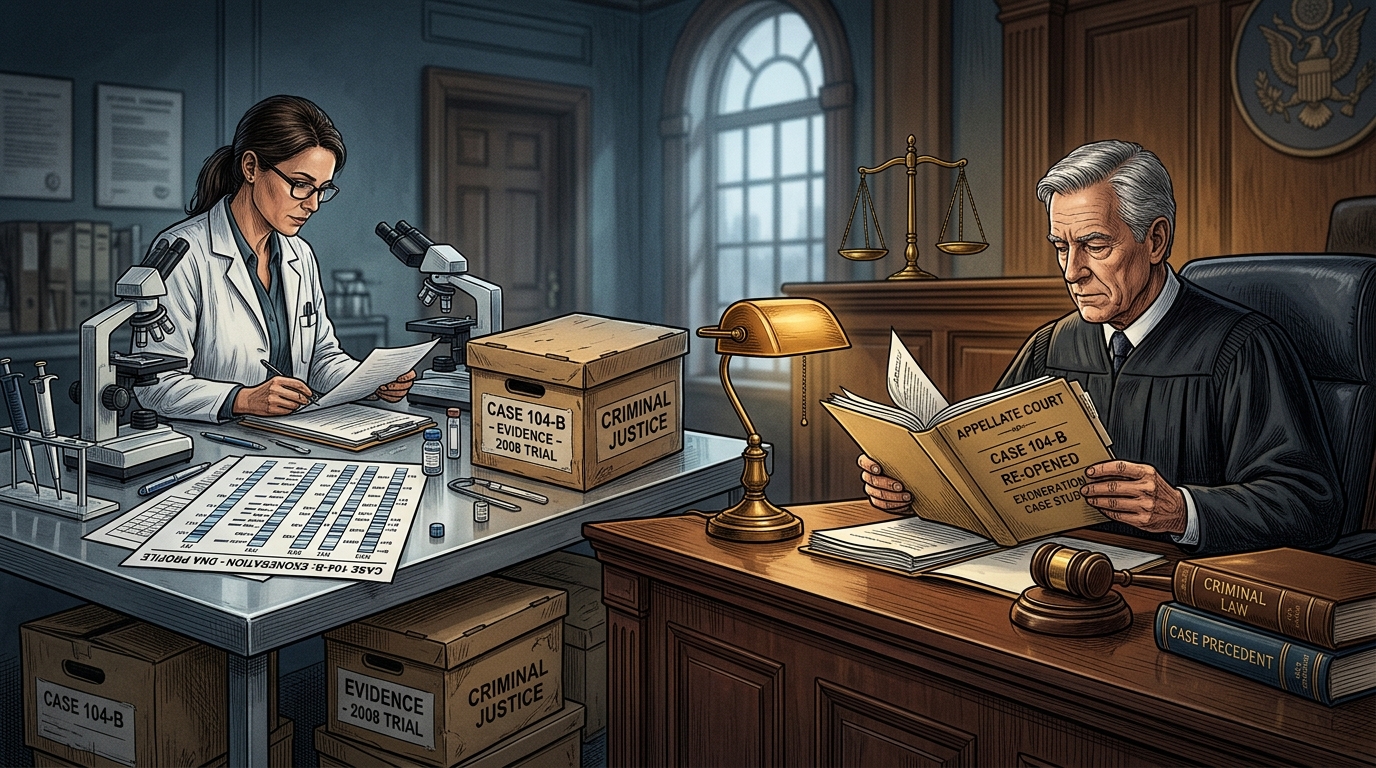
Over the past three decades, the National Registry of Exonerations has documented more than 3,400 wrongful convictions overturned in the United States, representing over 31,000 lost years behind bars. Beneath these numbers lies a sobering judicial reality: false accusations and flawed forensic testimony can dismantle constitutional due process with surgical finality.
Case Dossier: Exoneration Metrics
| Primary Research Base | The Innocence Project & National Registry of Exonerations |
| Total Documented Exonerations | 3,400+ Confirmed Judicial Reversals |
| Leading Cause of False Accusation | Eyewitness Misidentification (Contributing in ~69% of DNA cases) |
| Secondary Cause | Unvalidated / Discredited Forensic Testimony (~43% of cases) |
| Primary Legal Mechanism | Post-Conviction Habeas Corpus (Actual Innocence Gateway) |
| Constitutional Basis | Fourteenth Amendment Due Process & Sixth Amendment Counsel |
1. Eyewitness Misidentification: The Psychological Anatomy of False Accusations
Decades of cognitive neuroscience and criminal trial research have confirmed that human memory does not operate like a digital recording device. Memory is malleable, reconstructive, and highly susceptible to contamination during post-event police procedures.
In roughly 69% of the Innocence Project’s first 375 post-conviction DNA exonerations, mistaken eyewitness identification was the central pillar of the prosecution’s case. Victims and witnesses frequently misidentify innocent suspects in high-stress scenarios—particularly in cross-racial identifications—due to subconscious cues, suggestive photo lineups, and confirmation feedback from law enforcement officers.
Once a witness makes an initial, tentative selection, psychological commitment bias takes hold. By the time the witness takes the stand before a jury, their confidence is often 100% absolute, presenting an extraordinarily persuasive spectacle for jurors who correlate certainty with factual accuracy.
2. The Collapse of Junk Forensic Science
Perhaps the most disturbing category of false accusations stems not from malicious individuals, but from judicial reliance on unvalidated, pseudo-scientific forensic disciplines. Over forty percent of DNA exonerations involved the misapplication of forensic testimony:
- Microscopic Hair Comparison: In 2015, the FBI and Department of Justice conducted a historic review admitting that FBI forensic examiners gave flawed, scientifically invalid testimony regarding microscopic hair matches in over 90% of criminal trial transcripts reviewed across two decades.
- Bite Mark Analysis: The American Board of Forensic Odontology and the National Academy of Sciences (NAS) have concluded that bite mark comparison lacks scientific validity, repeatable error rates, or statistical foundation, leading to dozens of wrongful murder convictions being vacated.
- Faulty Arson Science: Historical fire investigation relied heavily on myths regarding glass crazing, floor pour patterns, and burn temperatures that modern thermodynamics has thoroughly debunked, resulting in landmark posthumous and actual innocence exonerations.
3. The Legal Gateway: Overcoming Procedural Bars via Habeas Corpus
Securing an exoneration is one of the most formidable procedural undertakings in American jurisprudence. Under the Supreme Court’s stringent standard in Herrera v. Collins (1993) and the Antiterrorism and Effective Death Penalty Act (AEDPA), federal courts have historically held that a freestanding claim of actual innocence is rarely sufficient on its own to overturn a state verdict without an accompanying constitutional violation during trial.
To secure post-conviction relief, defense attorneys must leverage the “Schlup Gateway” (Schlup v. Delo, 1995): establishing through newly discovered scientific evidence that no reasonable juror, conscientiously deliberating, would have found the accused guilty beyond a reasonable doubt, thereby unlocking review of constitutional defects such as ineffective assistance of counsel or Brady evidentiary suppression.
Companion YouTube Documentary
Watch our 15-minute video dossier: examining landmark Innocence Project trials, tracing how DNA technology exposed unvalidated courtroom science, and analyzing the legal reforms protecting due process.
Frequently Asked Questions
What is the most common cause of wrongful criminal accusations?
According to data from the Innocence Project and the National Registry of Exonerations, eyewitness misidentification is the single leading contributor to wrongful convictions, appearing in approximately 69% of DNA exonerations, followed closely by unvalidated forensic testimony and false confessions.
What is a Brady violation in a criminal trial?
Under the landmark Supreme Court ruling Brady v. Maryland (1963), prosecutors are constitutionally obligated to turn over any exculpatory evidence favorable to the defense. Suppressing evidence of innocence or witness credibility constitutes a Brady violation, which routinely triggers conviction reversals.
How does post-conviction DNA testing work?
All fifty states have enacted post-conviction DNA access statutes. Defense counsel files formal motions requesting biological evidence preserved from the crime scene be subjected to advanced STR (Short Tandem Repeat) or STR-Y forensic analysis to exclude the convicted defendant as the biological source.
Case Discussion & Whistleblower Disclosure
Public Debate & Video Investigation
Public discussions and community analysis on this docket take place on our YouTube channel. Explore the companion video, breakdown of court exhibits, and contribute to the debate.
Watch & Discuss on YouTubeConfidential Whistleblower Tips
Possess primary court dockets, non-public corporate records, or verified evidence relevant to this investigation? Submit encrypted information directly to our investigative team.
Submit Confidential Tip