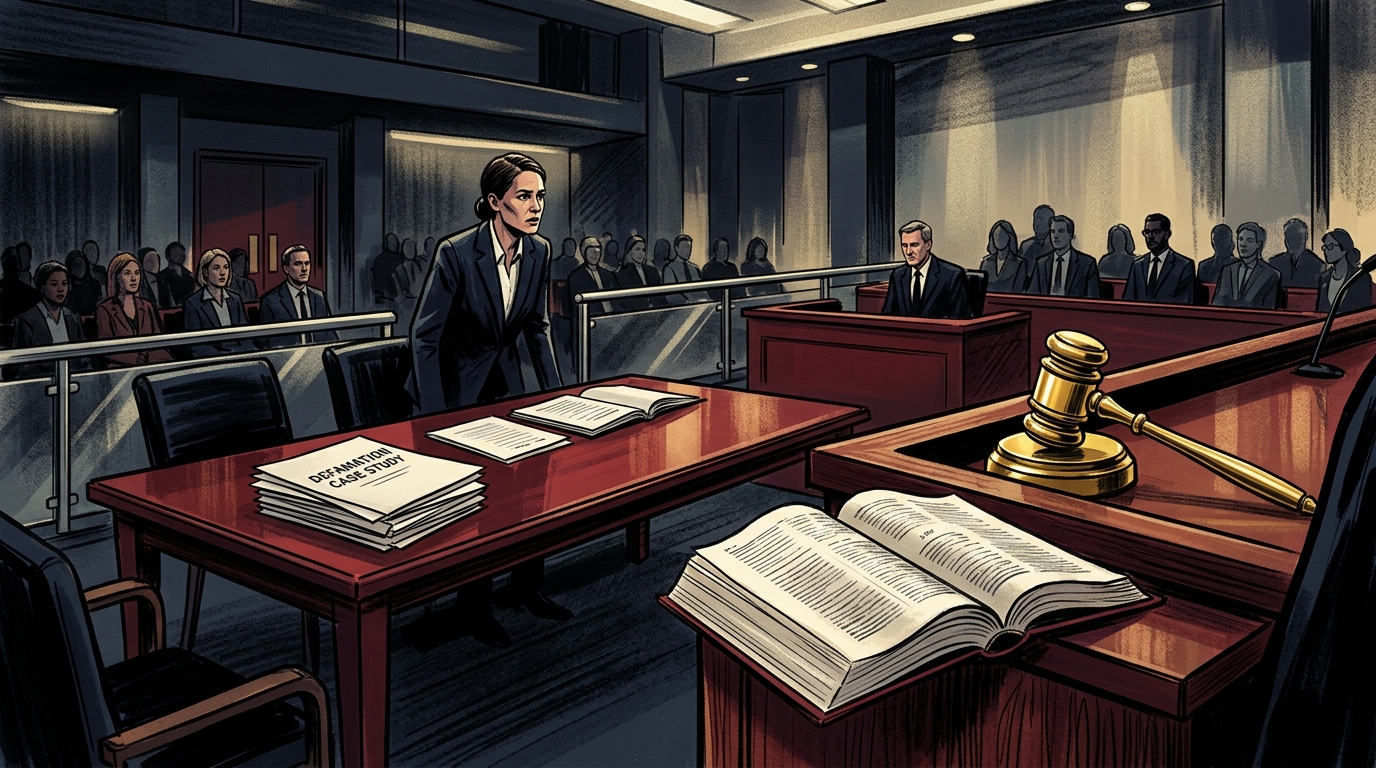
In the arena of public discourse and modern digital media, accusations carry velocity. A single viral headline, social media thread, or press conference can dismantle a career built over decades in under twenty-four hours. While the First Amendment fiercely protects robust political debate and genuine opinion, American tort law enforces a catastrophic line when accusations cross into falsehood: Defamation Per Se.
Case Dossier: Legal Fast Facts
| Primary Legal Doctrine | Defamation Per Se (Common Law Libel / Slander) |
| Statutory Restatement | Restatement (Second) of Torts §§ 569–574 |
| Evidentiary Standard (Private Figures) | Negligence (Gertz v. Robert Welch, Inc.) |
| Evidentiary Standard (Public Figures) | Actual Malice (New York Times Co. v. Sullivan) |
| Key Distinguishing Mechanism | Presumed General Damages (No proof of financial injury required) |
| Companion Video Documentary | Accuser Media YouTube Channel (14 Min Deep Dive) |
1. Normal Defamation vs. Defamation Per Se: The Vital Difference
To evaluate why certain civil lawsuits culminate in staggering eight-figure judgments, one must understand the sharp distinction between ordinary defamation (defamation per quod) and defamation per se.
In standard defamation, the plaintiff bears the onerous burden of proving what common law terms “special damages” (actual pecuniary loss). If a defendant falsely states that an accountant is unpersonable, the accountant cannot merely argue hurt feelings or social embarrassment; they must provide audited receipts, cancelled client retainers, or specific contractual terminations demonstrating measurable economic injury resulting directly from that statement. If special damages cannot be proven, the lawsuit fails at summary judgment.
Defamation Per Se completely eliminates this requirement. Common law jurisprudence recognizes that certain specific classes of false accusations are so inherently virulent and destructive that injury to reputation is legally presumed as a matter of law. The plaintiff does not need to show they lost a dollar; the law assumes general damages the second the statement is communicated to a third party.
2. The Four Historical Categories of Defamation Per Se
Codified under the Restatement (Second) of Torts § 570, statements are defamatory per se if they impute to another person any of the following four conditions:
- 1. Commission of a Serious Criminal Offense: False statements imputing criminal conduct involving moral turpitude, felony status, or an offense punishable by imprisonment. Accusing someone of embezzlement, sexual assault, theft, bribery, or perjury falls squarely under this category.
- 2. Injury to Business, Trade, Profession, or Office: False statements that prejudice a person in their profession or trade. This includes falsely claiming a physician botched surgeries, an architect faked structural blueprints, an attorney is ethically compromised, or a scientist falsified clinical research trials.
- 3. Having a Loathsome, Contagious Disease: A historical common law category originally developed around infectious diseases carrying societal ostracization (e.g., historical sexually transmitted infections or contagious diseases).
- 4. Serious Sexual Misconduct or Unchastity: Historically applied to moral turpitude, modernized state statutes apply this to egregious false accusations of sexual deviance, nonconsensual assault, or abuse.
3. The “In My Opinion” Fallacy: The Landmark Milkovich Precedent
A prevalent defense raised by publishers, commentators, and social media accusers is that prefacing an allegation with “In my opinion”, “I believe”, or “Allegedly” grants blanket immunity under the First Amendment. This is a profound legal misconception.
In the seminal 1990 United States Supreme Court decision Milkovich v. Lorain Journal Co. (497 U.S. 1), Chief Justice William Rehnquist dismantled this argument. The Court held that couching a factual accusation in the language of opinion does not erase its defamatory nature if the statement implies knowledge of undisclosed, verifiable defamatory facts.
“If a speaker says, ‘In my opinion John Jones is a liar,’ he implies knowledge of facts which lead to the conclusion that Jones told an untruth… Simply couching such statements in terms of opinion does not dispel these implications.”
— Chief Justice William Rehnquist, Milkovich v. Lorain Journal Co.
The definitive test established by modern courts is binary: Is the statement capable of being proven true or false? If an allegation makes an assertion that can be objectively verified through evidence, court records, or testimony, cloaking it in the guise of opinion offers no First Amendment protection.
4. Standards of Fault: Sullivan Actual Malice vs. Gertz Negligence
Once a statement is identified as defamatory per se, the outcome of the litigation hinges on the constitutional status of the person accused:
| Plaintiff Status | Constitutional Standard | Governing Precedent | Burden of Proof |
|---|---|---|---|
| Public Official / Public Figure | Actual Malice | New York Times Co. v. Sullivan (1964) | Plaintiff must prove defendant published with knowledge of falsity OR reckless disregard for truth. |
| Private Individual | Negligence | Gertz v. Robert Welch, Inc. (1974) | Plaintiff must show defendant failed to act with reasonable care in verifying facts. |
While public figures must pierce the extraordinarily high shield of actual malice—proving the accuser possessed subjective, conscious doubts regarding the veracity of the claim—private citizens face a far more attainable threshold. An individual who is not a celebrity or politician need only demonstrate that the accuser acted carelessly or failed to conduct reasonable journalistic verification before publishing.
5. Landmark Case Studies: When Juries Strike Back
Recent litigation in American courtrooms demonstrates a distinct judicial and jury pushback against unchecked extrajudicial accusations:
The David M. Sabatini Trial (Massachusetts, 2024): In one of the most prominent recent academic defamation trials, former MIT biology professor David Sabatini sued his accuser over allegations that precipitated his termination from a world-renowned biomedical research laboratory. After an extensive trial featuring cross-examination, contemporaneous written records, and sworn testimony, a jury found the accusations constituted actionable defamation and awarded $6 million in damages.
The Virginia Libel Verdict (Depp v. Heard, 2022): Demonstrating the potency of defamation per se through implication, a Virginia jury evaluated an op-ed that did not explicitly name the plaintiff, but clearly referenced allegations of domestic abuse. The jury concluded the statements were published with actual malice, awarding $15 million in compensatory and punitive damages (subsequently adjusted under statutory caps).
Companion YouTube Documentary
Watch the full 14-minute investigative documentary breakdown produced by the Accuser Media investigative desk. Includes courtroom audio exhibits, sworn deposition highlights, and a legal debate on the future of anti-SLAPP statutes.
6. Anti-SLAPP Statutes: The Primary Defense Battlefield
In response to the risk of wealthy litigants using defamation suits to silence critics, over thirty-three states have enacted Anti-SLAPP legislation (Strategic Lawsuits Against Public Participation). Exemplified by California’s CCP § 425.16 and Texas’s TCPA, anti-SLAPP statutes provide a procedural expedited off-ramp for defendants facing meritless defamation claims concerning matters of public interest.
Under an anti-SLAPP motion, all discovery is frozen immediately, and the plaintiff must make a prima facie showing of probability of prevailing on the merits. If the plaintiff fails, the court must dismiss the case and order the plaintiff to pay all of the defendant’s attorney fees. However, when an accusation is provably fabricated or unsupported by admissible evidence, anti-SLAPP motions are denied, clearing the runway for severe punitive damage trials.
Frequently Asked Questions
What are the four categories of defamation per se?
Under common law and Restatement (Second) of Torts § 570, the four categories are: (1) false accusations of committing an infamous or serious crime, (2) false accusations injuring someone in their professional trade, business, or office, (3) false claims of having a loathsome contagious disease, and (4) false accusations of severe sexual misconduct or moral turpitude.
Why are damages presumed in defamation per se?
Because the law recognizes that allegations attacking someone’s professional integrity or accusing them of serious felonies cause immediate, irreversible harm to reputation that cannot easily be calculated on an invoice. Therefore, the plaintiff is not required to prove specific out-of-pocket financial losses to recover general damages.
Does saying “in my opinion” protect an accuser from a lawsuit?
No. Under the Supreme Court precedent Milkovich v. Lorain Journal Co. (1990), preface statements like “in my opinion” or “allegedly” do not shield a speaker if the underlying statement implies provably false factual assertions.
What is the difference between defamation per se and defamation per quod?
Defamation per se involves statements so obviously defamatory on their face that damages are presumed automatically. Defamation per quod requires extrinsic facts to show why the statement was harmful and requires the plaintiff to prove specific economic damages (special damages).
Case Discussion & Whistleblower Disclosure
Public Debate & Video Investigation
Public discussions and community analysis on this docket take place on our YouTube channel. Explore the companion video, breakdown of court exhibits, and contribute to the debate.
Watch & Discuss on YouTubeConfidential Whistleblower Tips
Possess primary court dockets, non-public corporate records, or verified evidence relevant to this investigation? Submit encrypted information directly to our investigative team.
Submit Confidential Tip