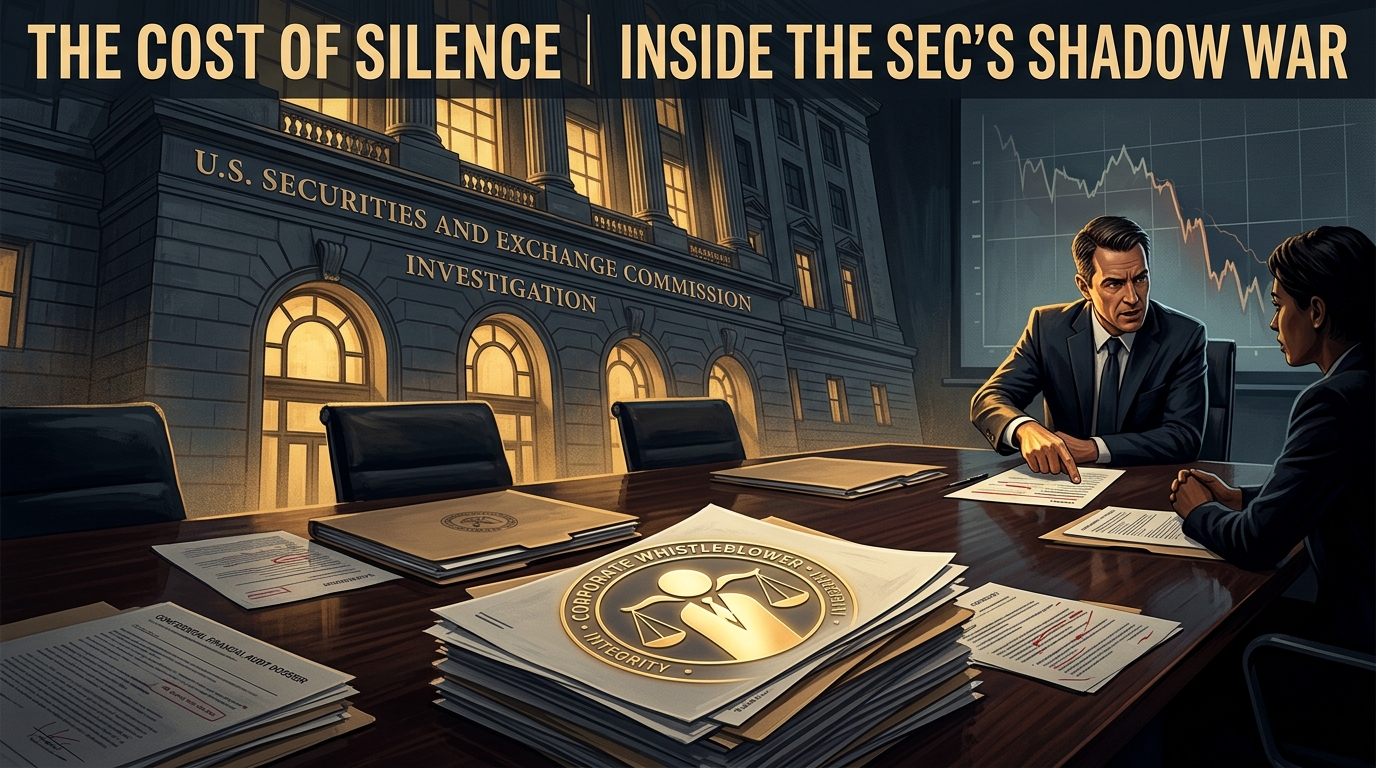
In May 2023, the United States Securities and Exchange Commission announced a jaw-dropping bounty: $279 million awarded to a single anonymous whistleblower. More than doubling the previous record of $114 million set in 2020, this historic payout permanently cemented corporate whistleblowing as one of the most lucrative—and perilous—frontiers in modern federal enforcement.
Case Dossier: SEC Whistleblower Record
| Enforcement Agency | U.S. Securities and Exchange Commission (SEC) |
| Bounty Award Amount | $279 Million (Single Individual Whistleblower) |
| Governing Statute | Dodd-Frank Wall Street Reform Act (15 U.S.C. § 78u-6) |
| Statutory Bounty Range | 10% to 30% of total monetary sanctions collected |
| Underlying Enforcement Sanctions | Over $1.1 Billion in disgorgement and civil penalties |
| Identity Status | Completely Redacted & Protected by Federal Law |
1. The Dodd-Frank Framework: Turning Insiders into Relators
Prior to the 2008 financial crisis, corporate employees who discovered systemic accounting fraud, bribery, or insider trading faced a brutal dilemma: stay silent and risk regulatory complicity, or report internally and face immediate professional execution through retaliatory blacklisting.
Congress fundamentally altered this calculation by enacting Section 922 of the Dodd-Frank Wall Street Reform and Consumer Protection Act (15 U.S.C. § 78u-6). Dodd-Frank created the SEC Office of the Whistleblower, establishing a direct financial incentive mechanism funded entirely by investor protection reserves—not taxpayer dollars.
- The 10%–30% Mandate: When a whistleblower’s original information leads directly to successful SEC enforcement action resulting in monetary sanctions exceeding $1 million, the SEC is statutorily required to pay between 10% and 30% of collected funds.
- Original Information Requirement: Information cannot be derived from public media, government hearings, or public regulatory filings. It must stem from the whistleblower’s independent knowledge or independent analytical research.
- Total Anonymity Protections: Whistleblowers can submit disclosures anonymously through legal counsel, preserving confidentiality throughout the entire investigation and settlement proceedings.
2. Anatomy of the $279M Record: How Bounties Are Calculated
How did a single whistleblower capture $279 million? Under SEC administrative guidelines, the exact bounty percentage within the 10%–30% statutory band is determined by four aggravating factors that increase awards and three mitigating factors that decrease them:
| Factors Increasing Bounty % | Factors Decreasing Bounty % |
|---|---|
| Significance of original information provided | Culpability or involvement in the underlying misconduct |
| Degree of ongoing cooperation and assistance | Unreasonable reporting delay that allowed harm to compound |
| Internal compliance reporting utilization first | Interference with internal compliance or audit systems |
| Programmatic deterrence value against market fraud | Failure to assist staff during enforcement inquiries |
In the $279 million order, the SEC noted that while the claimant did not initiate the original inquiry, their subsequent detailed disclosure and ongoing analytical assistance expanded the scope of charges to encompass entirely new categories of misconduct, leading to over $1.1 billion in civil penalties and corporate disgorgement.
3. Retaliation Shields: Legal Protections for Accusers
The cornerstone of federal whistleblower jurisprudence is anti-retaliation enforcement. Employers frequently attempt to gag insiders through aggressive Non-Disclosure Agreements (NDAs), clawback clauses, or immediate termination. However, federal law aggressively penalizes these maneuvers:
Rule 21F-17(a) Violations: The SEC strictly prohibits corporations from taking any action to impede an individual from communicating directly with SEC staff, including enforcing confidentiality agreements. The Commission has levied multi-million dollar penalties against major corporations simply for drafting severance contracts that required departing employees to waive whistleblower reward rights.
Private Right of Action: Under Dodd-Frank, whistleblowers who experience retaliatory discharge are entitled to reinstatement, double back pay with interest, and reimbursement for all attorney fees and court litigation expenses.
Companion YouTube Documentary
Watch our comprehensive video investigation on the SEC Whistleblower Office: tracing how anonymous corporate tips trigger federal subpoenas, how forensic audits pierce corporate secrecy, and how relators navigate high-stakes litigation.
Frequently Asked Questions
Can an SEC whistleblower remain completely anonymous?
Yes. Under SEC regulations, a whistleblower can file anonymously through a licensed attorney. The whistleblower’s identity is not revealed to the public, the target corporation, or even federal dockets, and remains confidential even after multi-million dollar awards are disbursed.
What percentage of penalties do SEC whistleblowers receive?
By federal statute, whistleblowers receive between 10% and 30% of all monetary sanctions collected by the SEC and related agencies, provided the total recovery exceeds $1,000,000.
Where does the bounty money come from?
Whistleblower awards are paid exclusively out of the SEC Investor Protection Fund, which is financed entirely by monetary penalties paid by corporate securities law violators. No money is taken from harmed investors or taxpayers.
Case Discussion & Whistleblower Disclosure
Public Debate & Video Investigation
Public discussions and community analysis on this docket take place on our YouTube channel. Explore the companion video, breakdown of court exhibits, and contribute to the debate.
Watch & Discuss on YouTubeConfidential Whistleblower Tips
Possess primary court dockets, non-public corporate records, or verified evidence relevant to this investigation? Submit encrypted information directly to our investigative team.
Submit Confidential Tip